What is a template website?
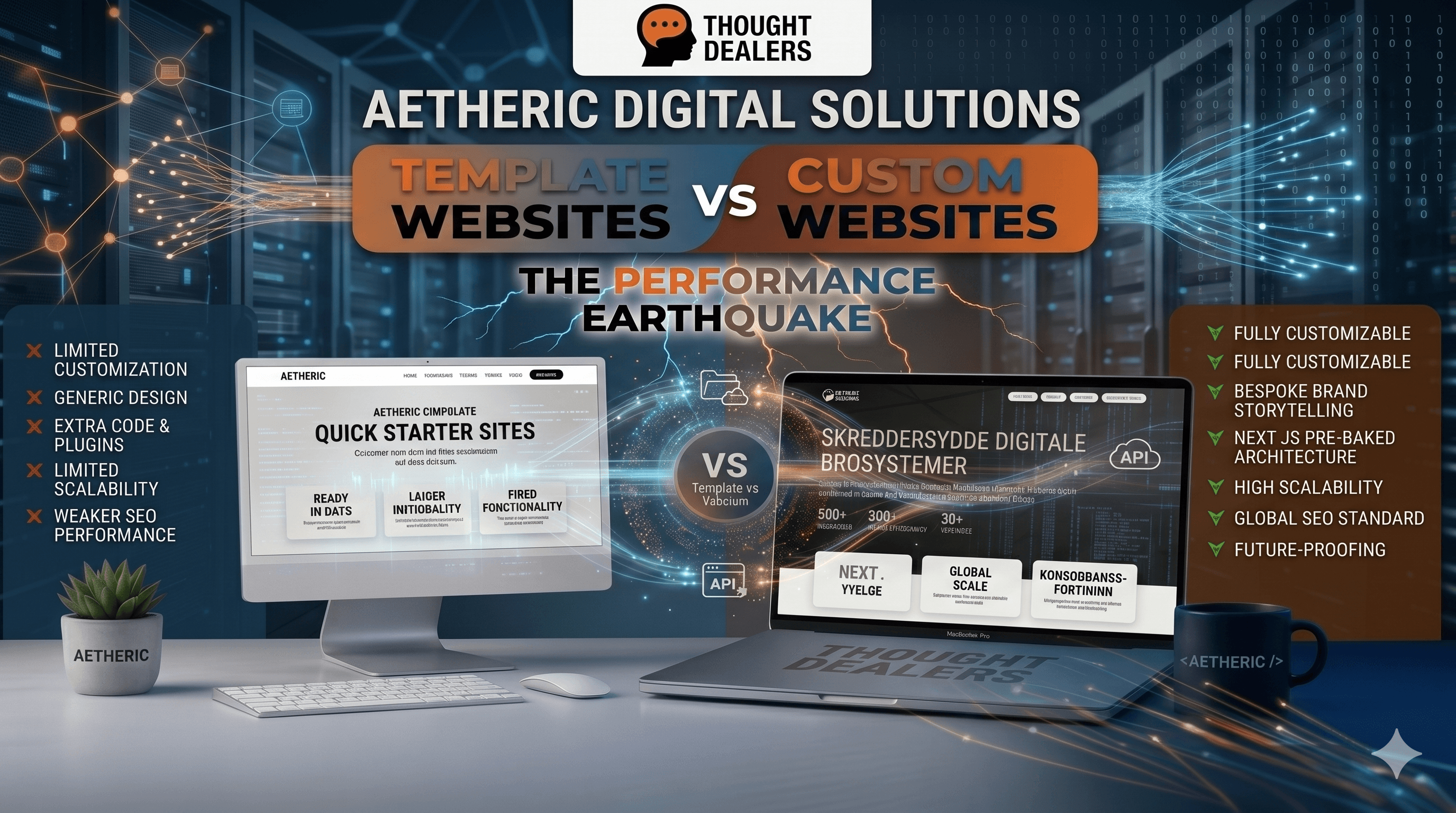
A template vs custom website comparison is important when deciding how to build your online presence. A template website is built using a pre-designed structure that is created for general use. Instead of designing a website from scratch, businesses choose a ready-made layout and simply replace the text, images, and branding.
This approach makes website creation fast, affordable, and easy to manage, especially for small businesses or early-stage projects. However, because the same templates are used across many websites, the final result often looks and feels similar across different industries.
In practice, a template website is not designed specifically around your business. It is a general system that you adapt to your content and brand.
What is a custom Next.js website?
A custom website built with Next.js is developed from the ground up based on business goals, user experience, and performance requirements. In the template vs custom website discussion, this is where the biggest difference becomes clear. Instead of using a pre-made layout, everything is designed and built specifically for the company.
Next.js is a modern web development framework that allows developers to create fast, scalable, and highly optimized websites. It is widely used for professional websites where performance, SEO, and flexibility are important.
Unlike template websites, every element in a custom Next.js website is intentional. The structure, design, and functionality are all built specifically for the business, not adapted from a general system.
Template vs custom website: key differences in performance
In the template vs custom website comparison, performance is one of the most important factors.
Template websites often include unnecessary code, plugins, and design features that slow down loading speed. Because they are built to serve many users at once, they are not optimized for a specific business.
Custom Next.js websites are built with performance as a priority. The code is clean, optimized, and structured for the exact needs of the project. This results in faster loading times, better user experience, and improved engagement.
Since website speed is also a ranking factor for Google, performance directly affects SEO results.
SEO difference in template vs custom website development
Search engine optimization is another major factor in the template vs custom website decision.
Template websites often have limited technical SEO control. While basic SEO settings are available, the underlying structure is not always optimized for search engines. This can make it harder to compete in competitive industries.
Custom Next.js websites offer full control over technical SEO. Developers can optimize structure, metadata, and content delivery in a way that search engines can understand more efficiently. With server-side rendering, pages can also be indexed faster and perform better in search results.
Over time, this leads to stronger organic traffic growth and better visibility on Google.
Design and brand differences
The template vs custom website comparison also becomes very clear in design and branding.
Template websites are limited by predefined layouts. Even with customization, many websites end up looking similar, which reduces brand uniqueness.
Custom Next.js websites allow complete design freedom. Every visual element is created to match the brand identity and user experience. This creates a more professional and premium perception, faster load times, better user experience which directly influences trust and conversion rates.
In competitive markets, design quality often determines whether a visitor becomes a customer.
Scalability: what happens when your business grows
Scalability is another key part of the template vs custom website decision.
Template websites are suitable for simple use cases, but they often become restrictive as a business grows. Adding advanced features, integrations, or automation can become difficult or require rebuilding the website entirely.
Custom Next.js websites are built to scale. They can support integrations with CRMs, booking systems, APIs, automation tools, and even AI systems without structural limitations.
This makes custom development a long-term solution for growing businesses.
When a template website is enough
In the template vs custom website comparison, template websites still have a valid place.
They are useful when speed is more important than customization, such as early-stage businesses, temporary landing pages, or simple online presence needs.
They offer a fast and cost-effective way to launch a website, especially when advanced functionality is not required.
When custom Next.js development is the better choice
A custom website becomes the better option when the goal is growth, visibility, and lead generation. This is where the template vs custom website difference becomes a strategic business decision rather than just a technical one.
This is especially important for businesses in competitive industries where website performance, trust, and user experience directly affect revenue. In these cases, the website is not just a digital page. It becomes part of the marketing and sales system.
Final conclusion
The difference in a template vs custom website is not just technical. It is strategic.
Template websites focus on speed and simplicity. Custom Next.js websites focus on performance, scalability, and long-term growth.
For businesses that want to compete seriously online, the website becomes a core business asset that drives visibility, trust, and client acquisition.