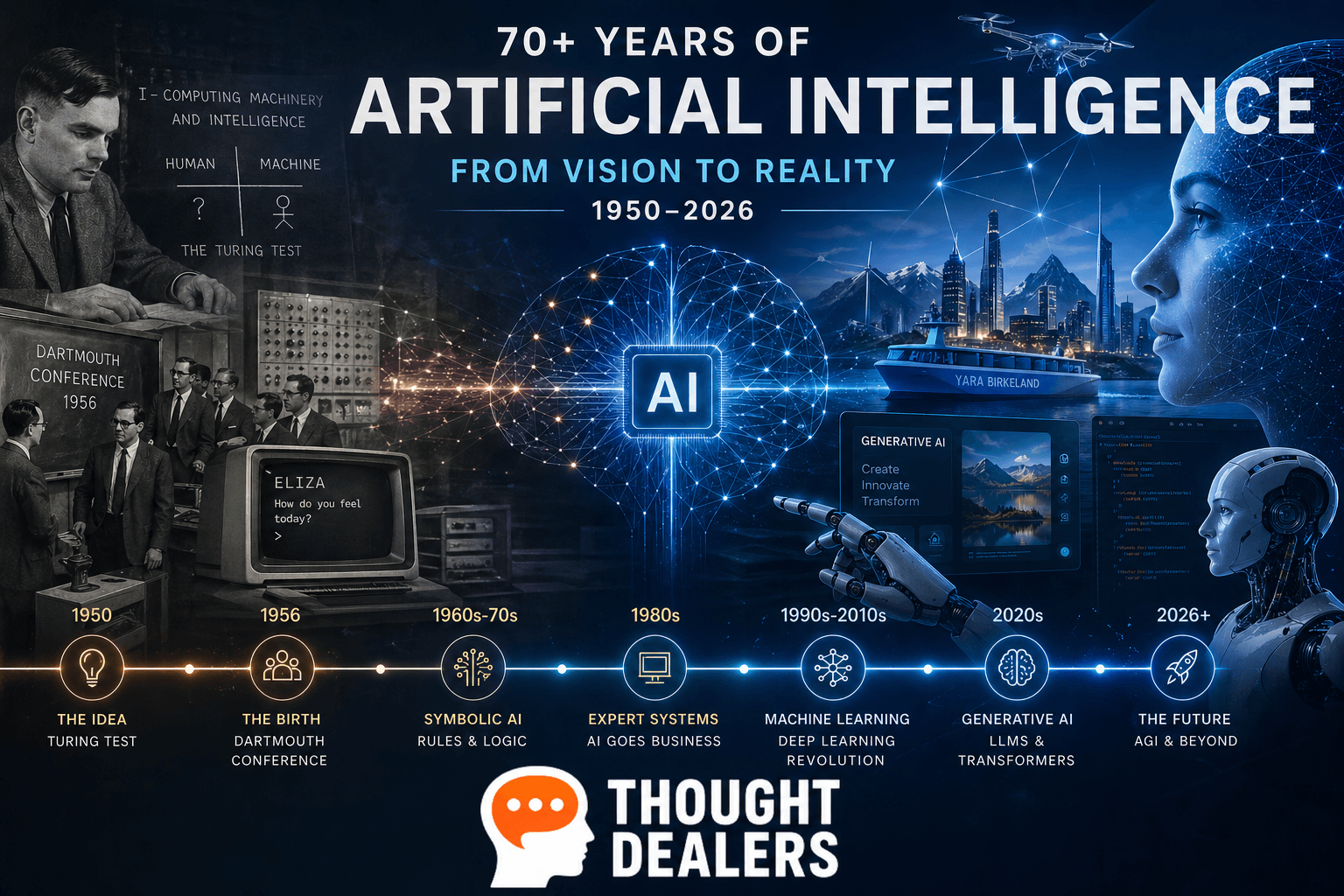
The Philosophical Foundations (1950–1956): When Machines First "Dreamed"
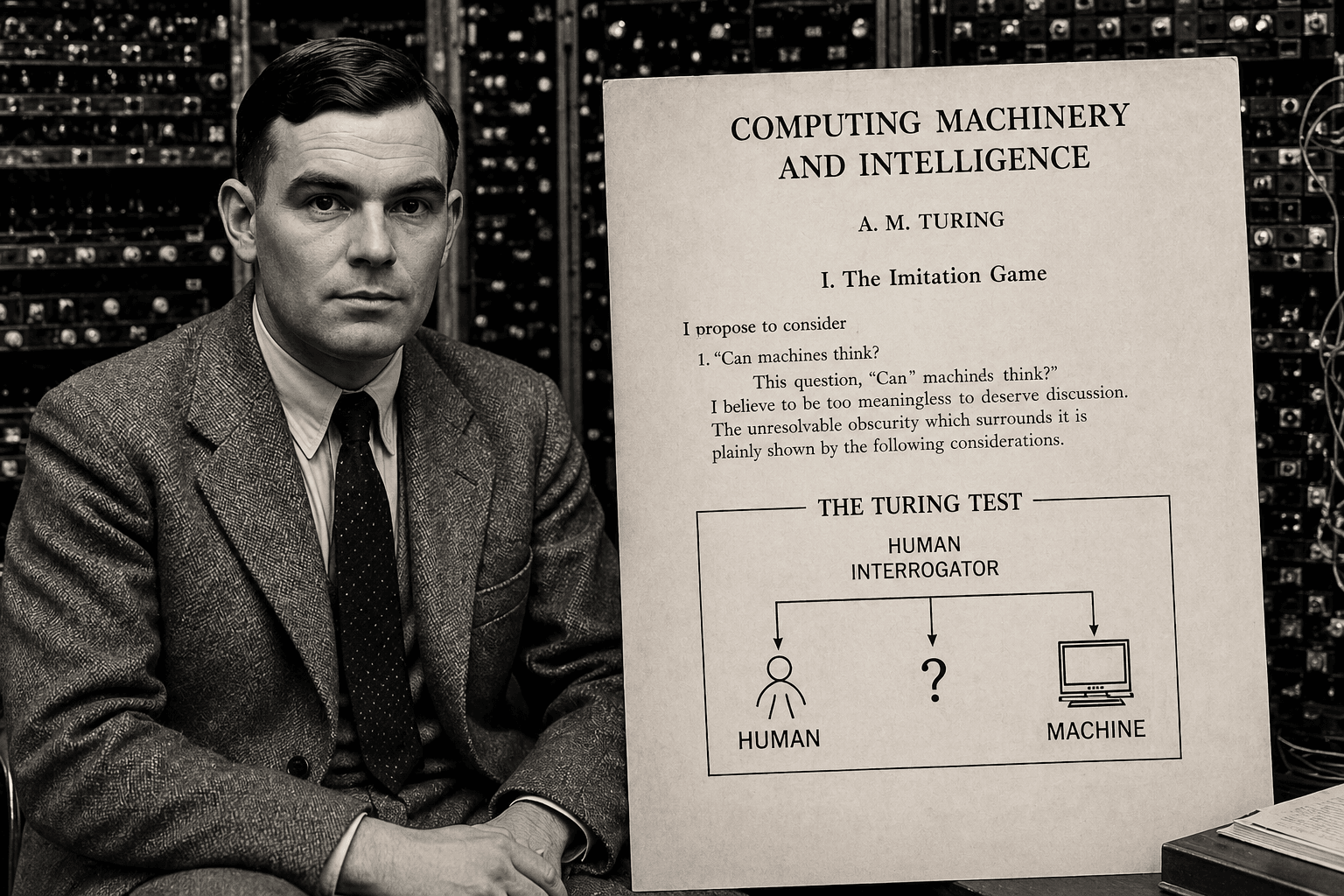
The journey did not begin with silicon chips, but with a question. In 1950, British mathematician Alan Turing published his seminal paper, Computing Machinery and Intelligence.
The Turing Test: The Original Benchmark
Turing proposed what he called the "Imitation Game." He argued that if a human judge, through a text-based conversation, could not reliably distinguish a machine from a human, the machine could be said to possess intelligence. Even in 2026, as we debate the "sentience" of AI, the Turing Test remains the ultimate philosophical North Star.
The Dartmouth Workshop (1956)
The official birth of AI as an academic field occurred at Dartmouth College. Here, icons like John McCarthy, Marvin Minsky, and Claude Shannon gathered with a bold premise: that every aspect of learning or any other feature of intelligence can in principle be so precisely described that a machine can be made to simulate it. This was the moment the term "Artificial Intelligence" was etched into history. The Rollercoaster of Progress: Artificial Intelligence Winters and Springs. Understanding AI’s history requires understanding why it took 70 years to reach your smartphone. The field has moved in cycles of extreme optimism followed by "AI Winters."
The Rollercoaster of Progress: Artificial Intelligence Winters and Springs
Understanding AI’s history requires understanding why it took 70 years to reach your smartphone. The field has moved in cycles of extreme optimism followed by "AI Winters."
1. The Era of Symbolic AI (1950s–1970s)
Early researchers focused on "Top-Down" AI. They believed that if they programmed enough logical rules, the machine would become intelligent.
- The Logic Theorist (1955): Often called the first AI program, it proved mathematical theorems.
- ELIZA (1966): The world’s first "chatbot," which simulated a psychotherapist.
- The First Winter: By 1974, the hype met a wall. Computers lacked the processing power to handle common-sense reasoning, leading to a massive withdrawal of government funding in the US and UK.
2. The Rise of Expert Systems (1980s)
In the 1980s, AI moved into the corporate world through "Expert Systems." These were programs designed to mimic the decision-making of a human expert in a specific niche (e.g., oil prospecting or medical diagnosis). While commercially successful for a time, they were brittle and expensive to maintain, leading to the Second AI Winter in the late 80s.
3. The Connectionist Revolution (1990s–2010s)
This period shifted from "Top-Down" rules to "Bottom-Up" learning. Instead of telling a computer what a cat is, researchers started showing the computer millions of pictures of cats and letting it figure out the patterns.
- 1997: IBM’s Deep Blue defeated Garry Kasparov.
- 2012: The AlexNet moment. A deep neural network shattered world records in image recognition, proving that Deep Learning was the future.
How Artificial Intelligence Works in 2026: The Technical Core
To dominate the SEO landscape, one must provide technical depth. Modern AI is built on three pillars that have reached their zenith in 2026.
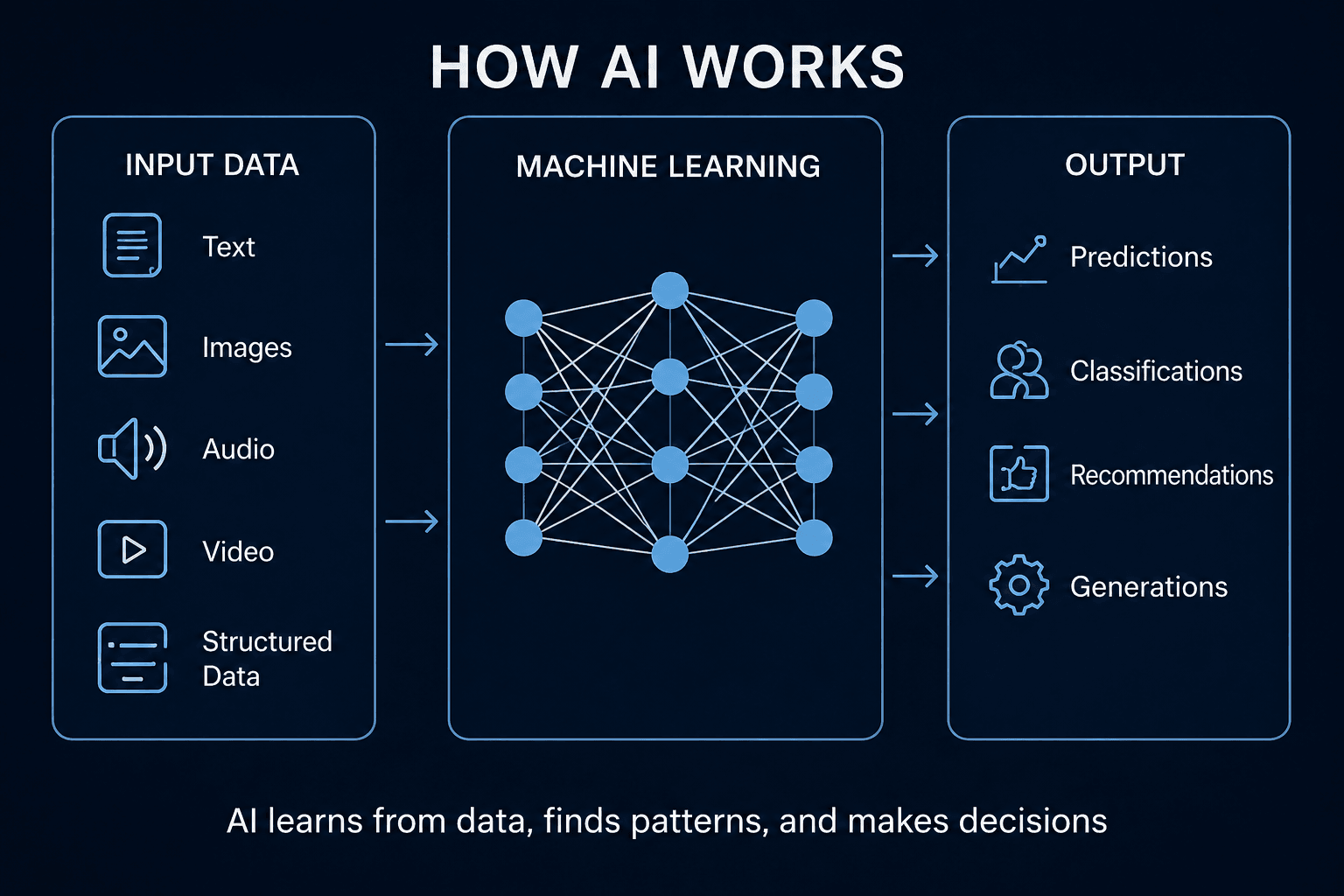
1. Machine Learning (ML) and Deep Learning
Machine Learning is the broad science of getting computers to act without being explicitly programmed. Deep Learning is a subset of ML that uses Artificial Neural Networks with many layers. In 2026, these networks have trillions of parameters, allowing them to grasp nuances in human emotion, complex coding syntax, and even protein folding in biology.
2. The Transformer Architecture: The "T" in GPT
The 2017 paper "Attention Is All You Need" changed everything. It introduced the Transformer model, which uses a mechanism called "Self-Attention."
- Contextual Awareness: Unlike older models that processed words in order, Transformers look at an entire document simultaneously. They understand that the word "bank" in "river bank" is different from "bank account" based on the surrounding text.
- Parallelization: This architecture allowed AI to be trained on massive GPUs, making the processing of the entire internet’s worth of data possible.
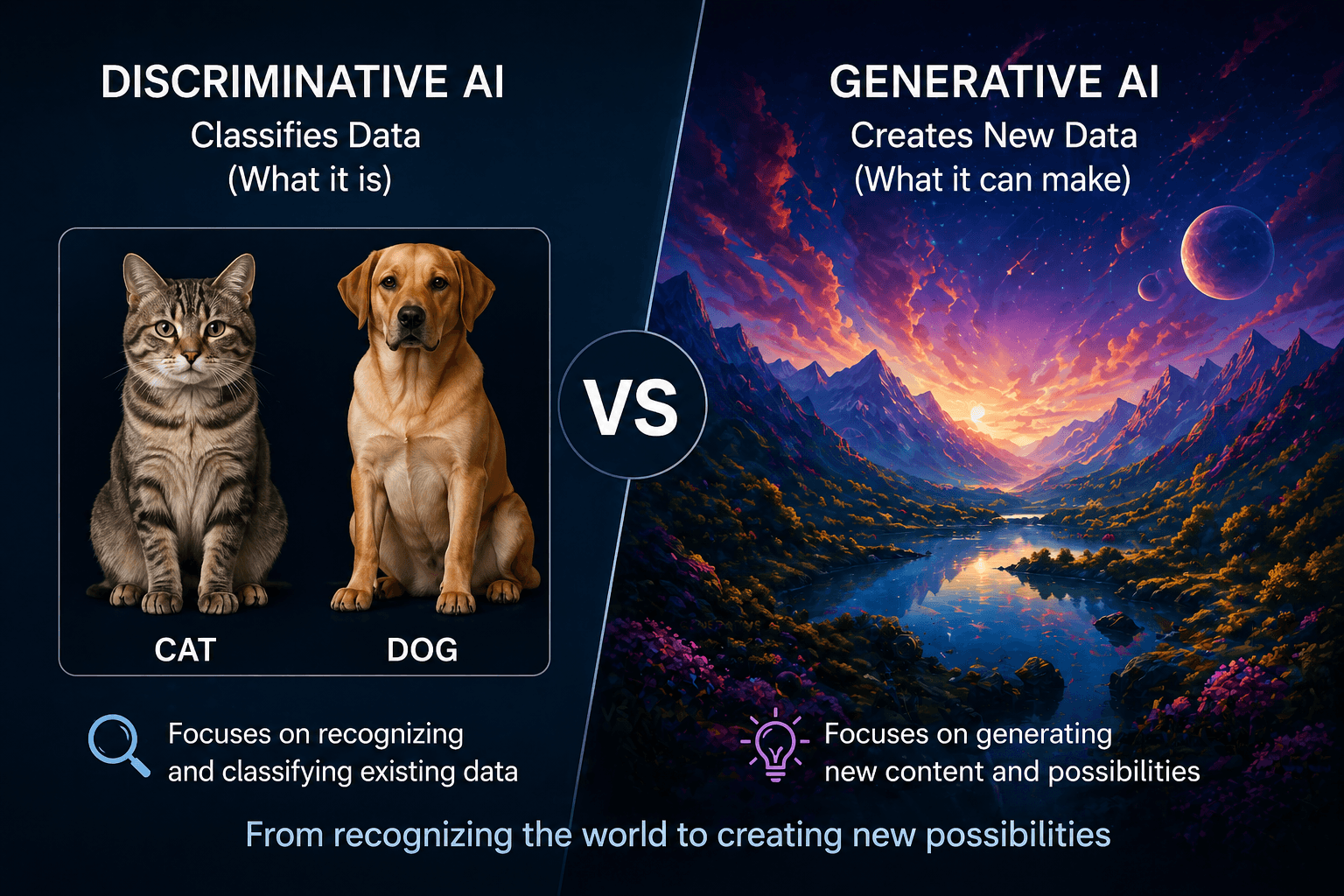
3. Generative Artificial Intelligence vs. Discriminative AI
For decades, AI was Discriminative (it could classify a photo as a dog or a cat). Today, we live in the era of Generative AI. Using Large Language Models (LLMs) and Diffusion Models, AI can now synthesize entirely new data writing poetry, generating photorealistic video (Veo/Sora), and composing symphonies.
Global Market Analysis: The USA and Norway
The application of AI varies significantly by region. For a global strategy, one must analyze the two leading approaches.
The United States: The Engine of Scale
In the USA, AI is driven by venture capital and "Big Tech" (Microsoft, Google, Meta, OpenAI).
- Productivity Powerhouse: US companies are focusing on Agentic AI systems that don't just draft emails but autonomously manage supply chains and execute complex software engineering tasks.
- Economic Impact: AI is currently the primary driver of the S&P 500, with companies pivoting entirely to "AI-First" strategies.
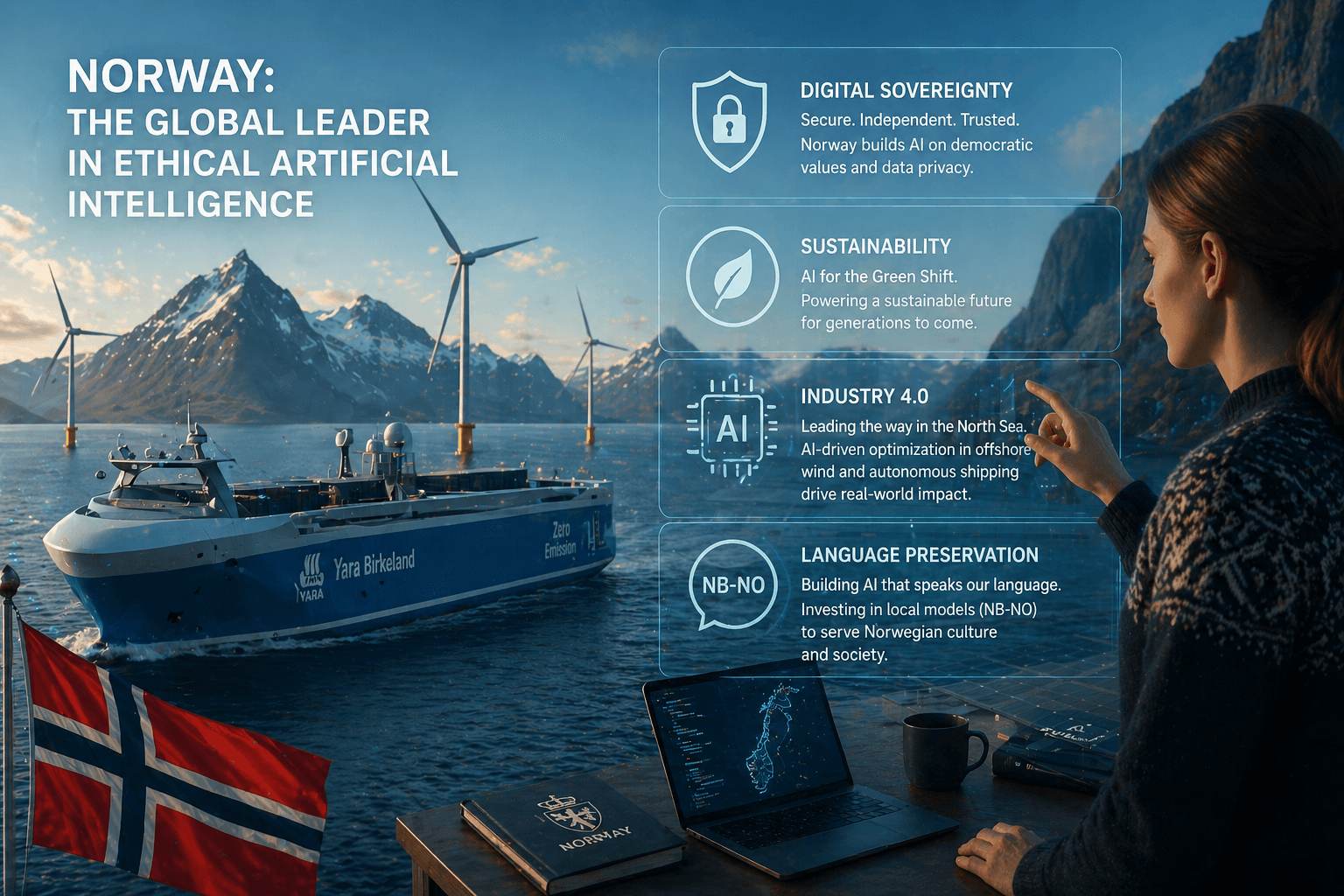
Norway: The Global Leader in Ethical Artificial Intelligence
Norway represents the gold standard for responsible AI implementation. As a leader in the Nordic tech scene, Norway focuses on Digital Sovereignty and Sustainability.
- The Norwegian AI Strategy: The Norwegian government has prioritized AI that aligns with democratic values and the EU AI Act.
- Industry 4.0 in the North Sea: Norway uses AI to lead the "Green Shift" . AI driven optimization in offshore wind farms and autonomous shipping (like the Yara Birkeland) are world-leading examples.
- Language Preservation: Norway’s investment in local language models (NB-NO) ensures that AI serves the Norwegian culture, not just global English-speaking markets.
AI in Business: Strategic Implementation in 2026
If you are a business owner in 2026, AI is no longer optional. It is the new "electricity."
1. Marketing and Content Authority
SEO has shifted from keyword stuffing to Entity Authority. AI tools now allow brands to:
- Map out entire "Topic Clusters" in seconds.
- Perform real-time sentiment analysis on global customer feedback.
- Generate hyper-personalized video ads for every individual consumer.
2. Software Development and "No-Code"
The barrier to entry for building tech has collapsed. AI-powered "Copilots" allow non-technical founders to build complex applications by simply describing them. In Norway, this has led to a surge in "Micro-SaaS" startups.
3. Operations and Hyper-Automation
Using RPA (Robotic Process Automation) combined with AI, businesses are automating the "boring stuff." Data entry, invoice processing, and basic customer support are now 95% automated in leading firms.
Risks, Ethics, and the "Dark Side" of Intelligence
A truly authoritative guide must address the challenges.
- The Alignment Problem: How do we ensure that an AI's goals always align with human values? As AI becomes more autonomous, this is the #1 concern for researchers.
- Hallucinations and Truth: AI can generate "fake facts" with total confidence. In a world of "Deepfakes," the role of human verification (Fact-Checking) is more critical than ever.
- Environmental Impact: Training a single large model consumes as much energy as hundreds of homes do in a year. The move toward Green AI (efficient algorithms) is a major trend in 2026.
- Job Displacement: While AI creates jobs, it also automates others. The focus is now on "Augmentation" using AI to make humans 10x more effective, rather than replacing them.
Looking Ahead: The Road to AGI (2027–2030)
We are currently in the era of Narrow AI (AI that is good at specific tasks). The "Holy Grail" is AGI (Artificial General Intelligence) a machine that can learn any intellectual task that a human can.
What to Expect by 2030:
- Personal AI Twins: Everyone will have a digital assistant that knows their preferences, history, and goals, acting as a personal "Chief of Staff."
- Quantum AI: The fusion of Quantum Computing and AI could solve problems in days that would currently take thousands of years (like curing cancer or reversing climate change).
- Humanoid Robotics: AI is getting a "body." Companies like Tesla (Optimus) and Figure are integrating LLMs into robots that can perform manual labor.
Conclusion: The Opportunity of a Lifetime
Yes, Artificial Intelligence has existed for over 70 years. But for 68 of those years, it was a dream restricted to research labs. The last two years have changed the world forever.
We are living through the most significant technological shift since the Industrial Revolution. Whether you are a developer in Silicon Valley or a business leader in Oslo, the message is clear: The future belongs to the "AI Fluent." Understanding AI’s history gives you perspective. Mastering its current tools gives you power. Anticipating its future gives you a legacy